World Map
Java Service Wrapper is the easiest way to make your product more reliable.
  • Free Trial
  • Buy Now
Troubleshooting

Troubleshooting: Problems

Troubleshooting: Solutions

My Program is not running as fast as I expect.

In general, an application should run as fast under the Wrapper as it does when running standalone. Here are a few places to start looking.

Console Output

On some platforms, including Windows, sending large quantities of text to System.out or System.err will cause the program to slow down. This is because all of that output is being rendered to the screen in a graphics GUI environment. This is actually the OS eating the CPU rather than the Wrapper or your application but the end result is the same.

To significantly reduce this effect, use a logging tool which will output to a file rather than to stdout. By doing so, the output is never sent to the Wrapper or the user console and it results in reducing the burden.

Another option which is almost as good is to configure the Wrapper's console log level, using the wrapper.console.loglevel property, so that the output is only sent to the Wrapper's log file. Console output is disabled by default when running as a Windows Service and the console has not been enabled.

Memory

Make sure that your system has plenty of physical memory for the JVM to run without doing any disk swapping (virtual memory on hard disk). Because of the way Java manages memory, a very significant speed hit is common simply because Java is forced to do paging of large amounts of its memory as it attempted to perform "garbage collection".

Sun's Documentation

Another good place to look is the Performance Documentation for the Java HotSpot VM page on Sun's site. In addition, there was a very informative JDC Tech Tip talking about "Garbage Collection" issues.

I get an error about not being able to write a pid file when starting the Wrapper.

Strarting with Wrapper version 3.0.5, the wrapper.pidfile property was implemented on the Windows platform. Previous versions of the Wrapper ignored this property when running under Windows. However, if the wrapper.conf file that you are using was created using a version of the Wrapper prior to 3.0.0, then you may have this property defined as a holdout from when you copied the file from the example wrapper.conf. This will lead to an error like the following:

ERROR: Could not write pid file /var/run/testwrapper.pid: The
system cannot find the path specified. (0x3)

To resolve this simply edit your wrapper.conf file and remove the wrapper.pidfile property.

I am getting a warning that the Wrapper can not load its native library.

A few users have asked about the following message showing up in their wrapper.log file:

WARNING - Unable to load native library 'wrapper' for class WrapperManager.
          System signals will not be handled correctly.
This message is being shown because the Java component of the Wrapper was unable to load its native libraries during initialization. If you look in your wrapper.conf file, you will see a property, wrapper.java.library.path. This property is used to specify the directory that the Wrapper will look in to find its native library (Windows: wrapper.dll, Linux/UNIX: libwrapper.so). You should place the library file in the specified directory or change the property to point to the directory where the library is located.

As of Wrapper version 2.2.9, this error message was improved. You will now see something like the following (Depending on your platform of course):

WARNING - Unable to load native library 'wrapper' because the
          file 'wrapper.dll' could not be located in the following
          java.library.path:
            C:\SourceForge\wrapper\bin\..\lib
          Please see the documentation for the wrapper.java.library.path
          configuration property.
          System signals will not be handled correctly.

I am unable to install my application as a service under Windows 2000 or NT.

On Windows 2000 or NT, you will see the following error message if you attempt to install a service when logged in as a user without Administrator privileges.

OpenSCManager failed - access denied.

For this solution, contact your system administrator and beg them to install the service for you. Easy if that is you.

My Application will not start. What can I do to narrow down the problem?

Output describing the problem should be displayed in the console as well as the configured log file. To get more detailed output, edit your wrapper.conf file and enable debugging by uncommenting the wrapper.debug property. This will display very detailed output at every step in the process of launching and monitoring your application.

If your application works when not using the Wrapper, but fails with the Wrapper, then it is very likely that there is a problem in the way you set up your wrapper.conf file. Please look closely at the command used to launch Java, in the debug output. It is possible that there is a mistake in the classpath or something.

I am not getting any output in my configured log file.

It is possible that the Wrapper is not able to locate the specified Wrapper configuration file, or it is not able to open the configured log file for some reason. In either case, the Wrapper will log output to a file called wrapper.log in the current working directory. The current working directory will most likely be the directory containing the binary. However, in some cases, when running as a Windows Service, the wrapper.log file may be placed in your system directory (WinNT\System32).

My application is hanging while it is shutting down.

If you call System.exit() in your application, then Wrapper will catch this and attempt to shutdown the application cleanly. If during the shutdown process, your application once again calls System.exit(), then the call will block indefinitely causing your application to hang. There are also problems with calling the destroy() method on an AWT frame or window from within a Shutdown Hook thread. Please take a look at the wrapper.disable_shutdown_hook property in the Configuration Overview for details on how to avoid this problem.

My JVM version 1.2.x crashes when I run my application with the Wrapper.

Please see the list of supported JVMs (Java Virtual Machines). Java Service Wrapper version 3.4.x or later doesn't support JVM version 1.2.x any longer.

Most of the features of the Wrapper prior to version 3.4.x will work with version 1.2.x of JVMs. However, the released version of the Wrapper is built using a 1.4.x version of Java. 1.2.x version of the JVM have problems with the generated jar and will crash with very low level JNI errors. This appears to be a bug in the JVM 1.4.x versions of the compiler as it happens even if the JVM version 1.1 target is specified when compiling the classes.

Here is an example of the errors that I have seen:

A nonfatal internal JIT (3.10.107(x)) error 'chgTarg: Conditional' has occurred in :
  'org/tanukisoftware/wrapper/WrapperManager.stopCommon (II)V': Interpreting method.
  Please report this error in detail to http://java.sun.com/cgi-bin/bugreport.cgi

I get help from several people to be able to produce the releases for all of the various supported platforms and it is not really possible to force everyone to use old JDKs to build the Wrapper distributions.

If you are experiencing crash problems with JVMs 1.2.x version and the Wrapper, please try downloading a source distribution and building the wrapper.jar file using your JDK 1.2.x version. This will fix the problem.

If you are running into this, please post a note to the Wrapper-User Mailing List. I am not sure how many people are still using 1.2.x JVMs. But if it is still fairly common, I may reconsider the above policy and look into what it will take to get the releases built using an older JVM.

My JVM is sometimes restarted when the system is heavily loaded.

Because the Java Service Wrapper is using a pinging mechanism to check on the health of the JVM, it is possible that the Wrapper will think that the JVM is hung when it isn't if another process is taking 100% of the CPU for longer than 30 seconds. This will result in an entry like the following in your log file, and the JVM being restarted:

jvm 1    | 2001/12/01 12:23:23 | start()
wrapper  | 2001/12/01 12:23:44 | Startup failed: Timed out waiting for signal from JVM.
wrapper  | 2001/12/01 12:23:44 | JVM did not exit on request, terminated
wrapper  | 2001/12/01 12:23:49 | Launching a JVM...
jvm 2    | 2001/12/01 12:23:50 | Initializing...

The property wrapper.ping.timeout=30 in conf/wrapper.log can be used to extend this timeout. But be aware that this will also lengthen the amount of time that your application will remain hung in the event of a real problem.

My JVM hangs when shutting down after doing a thread dump.

The problem is that you might set the wrapper.java.command property to a batch file rather than directly to the java.exe. When requesting a thread dump, the "BREAK" signal is being sent to the process command.exe/shell rather than the Java process. It then forwards the signal on to the JVM but also sets an internal flag that CTRL-C has been pressed. When the child, Java exits, it immediately asks the user if they wish to stop or continue the batch script.

INFO   | jvm 1    | 2009/10/23 14:30:35 | WrapperManager Debug: Sent a packet STOPPED : 0
INFO   | jvm 1    | 2009/10/23 14:30:36 | Terminate batch job (Y/N)?
ERROR  | Wrapper  | 2009/10/23 14:30:56 | Shutdown failed: Timed out waiting for the JVM to terminate.
ERROR  | Wrapper  | 2009/10/23 14:30:56 | JVM did not exit on request, terminated
STATUS | Wrapper  | 2009/10/23 14:30:57 | <-- Wrapper Stopped

If you are needing to do some additional processing before or after the JVM is launched, the Java Service Wrapper Professional edition has the ability to do exactly that:Wrapper Event Configuration

I can't use the API call WrapperManager.requestThreadDump (Error 0x57)

This proplem is similar and caused by the same reason as the previous mention above.

INFO   | jvm 1    | 2009/10/23 14:35:48 |  WrapperJNI Error: Unable to send BREAK event to JVM process: The parameter is incorrect. (0x57)

If you are needing to do some additional processing before or after the JVM is launched, the Java Service Wrapper Professional edition has the ability to do exactly that:Wrapper Event Configuration

JBoss 6.* is outputting lots of "ERROR: Error installing to..." Errors at start-up when running with the Wrapper

INFO   | jvm 1    | 2011/01/06 17:23:05 | ERROR: Error installing to Configured: name=ServiceBindingManager state=Configured
INFO   | jvm 1    | 2011/01/06 17:23:05 | java.lang.Exception: Error calling callback JMXRegistrationAdvice for target context ServiceBindingManager
...

JBoss with version 6 is utilizing internally a MBeanServer Factory based on org.jboss.system.server.jmx.MBeanServerBuilderImpl, however this one is incompatible to the default JVM MBeanServerBuilder (javax.management.MBeanServerBuilder).

There are 2 options available to resolve this. First option is to disable the Wrapper's MBeans from getting registered. For this option please take a look at Integration Method 1. The second option is to tell the JVM to use the MBeanServer Factory which JBoss is using. More information about this can be found on the JMX Page.

The Wrapper is reporting an error/warning about its signature when starting.

wrapper  | A signature was found in "C:\wrapper-windows-x86-32-3.5.7-pro\bin\wra
pper.exe", but checksum failed: (Errorcode: 0x800b010a) 
A certificate chain could not be built to a trusted root authority. (0x800b010a)
wrapper  |   Signer Certificate:
wrapper  |     Serial Number: 
wrapper  |       00 97 06 fe b5 6e 56 cc cb 66 3a bb 55 a7 a0 e4 76 
wrapper  |     Issuer Name: UTN-USERFirst-Object
wrapper  |     Subject Name: Tanuki Software Ltd.
wrapper  |   TimeStamp Certificate:
wrapper  |     Serial Number: 
wrapper  |       47 8a 8e fb 59 e1 d8 3f 0c e1 42 d2 a2 87 07 be 
wrapper  |     Issuer Name: UTN-USERFirst-Object
wrapper  |     Subject Name: COMODO Time Stamping Signer
wrapper  |     Date of TimeStamp : 2010/12/19 22:32
wrapper  | The Wrapper will shutdown!

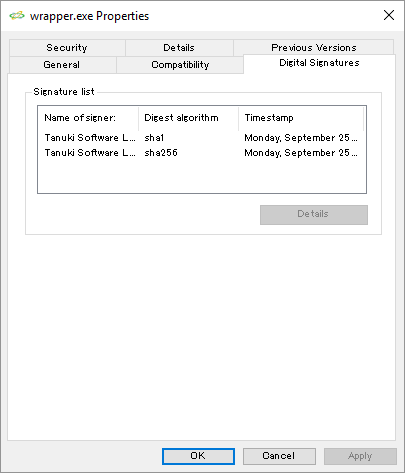
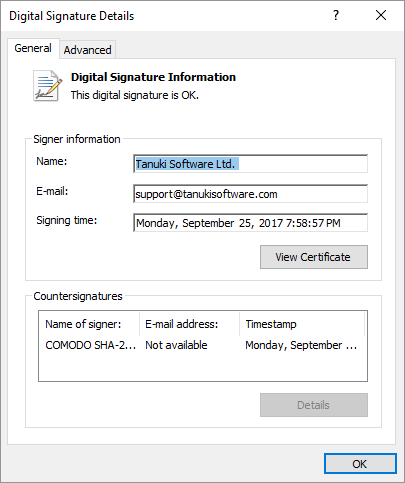
Starting with Wrapper version 3.5.7, all Windows binaries (i.e. wrapper.exe, wrapperW.exe and wrapper.dll) of all Wrapper Editions (Community, Standard, Professional) are using codesigning to verify the origin of the file from being from Tanuki Software. If any problem was detected, the Wrapper will shutdown.

The above error occured due to the counter-signer of our signature - Comodo's UTN-USERFirst-Object. The installed certificates can be investigated from the Windows Certificate Manager certmgr.msc. The UTN-USERFirst-Object Certificate should be present in the "Third Parties Root Certification Authorities\Certificates". If not, their root certificate can be downloaded from here:

https://support.comodo.com/index.php?_m=downloads&_a=viewdownload&downloaditemid=79

If it is present this might mean, the Local Security Policy of the server is too tight to allow the certificate to be verified. This settings can be found in the Local Security Policy of the server the "Public Key Policies"\"Certificate Path Validation Settings" and allows for the Root Certificate Store "Third-Party Root CAs and Enterprise Root CAs". If this doesn't/can't be set to active, another option would be to move the "UTN-USERFirst-Object Certificate" from the "Third Party Root CA" folder to the "Trusted Root Certificate Authorities" folder.

In Wrapper version 3.5.8, the Wrapper will only shutdown if the reason, the signature wasn't verified, was caused directly by the Wrapper, and not due to the counter-signer.

In Wrapper version 3.5.7, there was a bug potentially causing an access violation, when the Signature verification failed and the Wrapper was trying to report the error.

I can only run -N- services on Windows.

The Wrapper itself does not place any restrictions on the number of Wrapper instances which can be run on Windows at the same time, but both the Wrapper and especially Java consume various resources which can place limits on how many instances can be run on a given system. The most common resource which causes problems is the Desktop Heap. Please see the Solving Desktop Heap Problems page for more information.